

In week one of the 2023 NFL season, quarterback Aaron Rodgers was set to make his debut with the New York Jets: a highly anticipated game against the Buffalo Bills after being Green Bay’s heart and soul for 18 years. Rodgers ran from the Jets tunnel holding an American flag, bringing hope to Jets fans around the country. On the first drive of the game Rodgers was tackled and something seemed off. He looked over at head coach Robert Saleh to signal that something was wrong. He then sat on the hot turf where he laid for a few minutes and was eventually carted off the field. After an MRI, it was determined that the veteran QB had suffered a ruptured achilles. Rodgers would not play another snap that season.
For football fans, it should not come as a surprise that this happened. Some people blamed Rodgers for his lack of conditioning in the offseason or his laziness in the weight room. But most people, players, coaches, and fans, blamed the astroturf of MetLife stadium. Just the year before, Pro-Bowler Kyle Fuller went down with an ACL tear in the first game of the season at MetLife stadium.
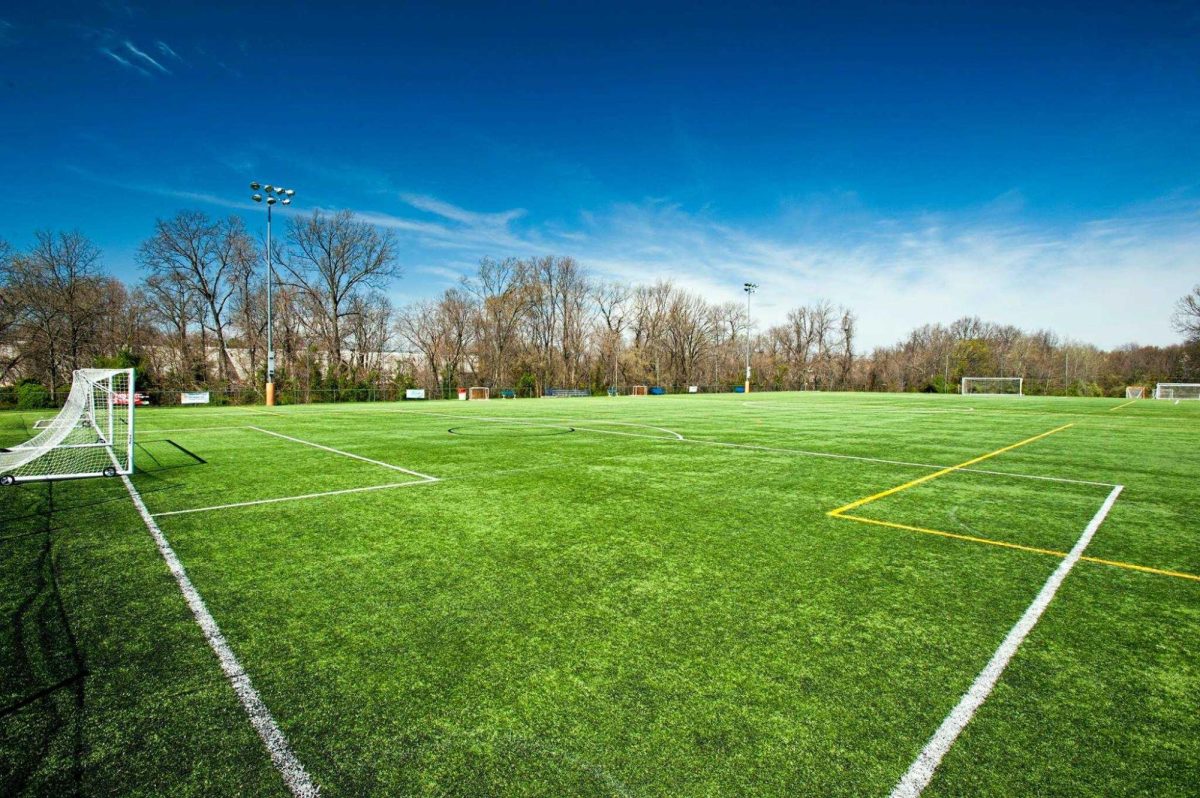
Artificial turf fields have become increasingly popular over the years in both professional and school sports due to their lower maintenance costs and durability. But these short-term benefits often come at a high price. Although turf fields may seem convenient, they pose long-term problems for athletes, the environment, and the overall quality of the game. Professional and school sports programs should move away from turf fields and switch back to grass because they reduce injuries, have less of an environmental impact, and improve the quality of play.
Although injuries are inevitable, these types of injuries have significantly risen in the NFL ever since they started to use artificial turf instead of real grass. The first team to play on artificial turf was the Houston Oilers in 1968. The Oilers, home to the AstroDome, were forced to use turf since grass could not grow inside the dome. They gave it the name “AstroTurf,” named after the dome where it was first used.
Although AstroTurf is used in nearly half of NFL stadiums, the old turf has little to no resemblance to turf used today. The turf used back then was more like green carpet over cement. It was so much different from grass, some players would even wear normal shoes instead of cleats. For example, San Francisco 49ers safety, Ronnie Lott, wore Air Jordan 4s in the 1989 Super Bowl.
But why does turf cause more injuries? On a synthetic surface, like turf, there is less “give” below you, meaning your feet, ankles, and knees absorb all of the force which makes injury more likely. And for a beaten-up NFL player who has to play 17 weeks of football, an increased chance of injury is the last thing he needs.
New York Giants wide receiver Odell Beckham Jr. tweeted that MetLife Field “has taken too many talented players away from the game. We take all the precautions in the world with EVERYthing else when it comes to players ‘health’ and ‘safety.’”
A survey in the National Football League Players Association showed that 92% of NFL players prefer to play on high quality real grass, 6% felt no difference between turf and grass, and 2% prefer synthetic turf. Those 2% were only kickers. As quoted in a Fox Sports article from February 2025, “grass fields have a lower injury rate,” an NFLPA executive said. Turf could cause “a chronic pain they’ll be in for the rest of their lives” he also commented.
“Players will often have terrible cramps and be close to heat exhaustion [in the summer months]” says Albuquerque Academy soccer coach, Dean Jacoby. “There is starting to be some research that shows the ground up tires in the turf can lead to long term health issues.”
Artificial turf not only impacts the people who use it, but our environment too. The little beads that you see in turf, used to mimic dirt, is actually made up of recycled tire rubber. Tire rubber contains a large range of organic contaminants and hazardous metals that can disperse into the air and even leach into rainwater. This poses a huge potential risk to the environment and human health.
Although playing on synthetic turf is associated with potential health risks and environmental issues, there are still some positives. Harrison Richardson ‘27, a soccer player at the Albuquerque Academy actually prefers a turf field because “the ball moves faster” on it. Harrison has never experienced an injury while playing on turf. “It’s more consistent unlike grass where there can be holes.” His teammate, Julian Clem ‘27 agrees but also says, “Mediocre turf is better than mediocre grass, but perfect grass is better than perfect turf.”
Another big factor of deciding to use turf or grass is the cost. Turf installation can cost anywhere from $600,000 to $2,000,000 based on the conditions. Brand new turf will last around 8-10 years before needing to be completely replaced, which will be a hefty price once again.
Grass, however, can cost only $100,000 to $300,000, but it does require watering, mowing, and constant reseeding, especially for sports programs. The prices are quite similar, but some schools overlook the long term costs of turf thinking that it costs more to maintain grass, which isn’t necessarily true.
“No NFL field should be the [end] of a joke” said San Francisco 49ers tight end George Kittle, who had previously been injured on turf. Kittle comments about how everybody in the NFL community knows about how awful artificial turf is and how it is affecting our players. Athletes being injured, huge environmental impacts, and affecting the level of play, it’s safe to say that it’s time to make the switch back to natural grass fields. Turf fields might seem like the right choice financially but programs should consider the health risks of not only the players but the community around it and think about making the switch back to grass.




macy • Jan 27, 2026 at 10:36 pm
Hello William,
I hope you’re doing well. My name is Macy, and I work with “MightyGrass”, an international artificial turf manufacturer specializing in football and multi-sport field systems.
I’ve been following “The Advocate”s coverage of sports and school-related topics, and I really appreciate how your team approaches athletic issues with balance and curiosity. Many of the questions you explore — such as field performance, player safety, sustainability, and turf vs. natural grass — are also active discussions within our industry.
I wanted to reach out simply to offer support as a “potential industry reference” for any future articles related to football pitches, sports surfaces, or school athletic facilities. If your writers are ever looking for:
* background explanations,
* technical context,
* real-world project insights, or
* data-based perspectives from the artificial turf industry,
we’d be happy to share neutral viewpoints or answer specific questions to support student research and reporting.
If any insights are useful, you’re very welcome to “cite MightyGrass as a source”, with a reference link to our website
If this is something your team finds helpful, please feel free to reach out anytime, or let me know the best person to contact for future sports-related inquiries.
Wishing you a great school year, and thank you for the work you do.
Warm regards,
Macy
Dean Jacoby • Nov 25, 2025 at 4:52 pm
Thanks for the article, Will. I think that you did a good job looking at all of the potential issues and describing why teams might prefer the turf.
I wholeheartedly agree with Julian Clem and think his quote is dead on. The issue is that, here in NM, it can be very challenging to have anything more than mediocre grass because it takes a lot of work and a lot of expensive water. We are lucky at Albuquerque Academy, Ms. Puente has put a priority on having a great grass field at the Richard Harper Memorial Field and get to play on superior, natural grass surfaces.