

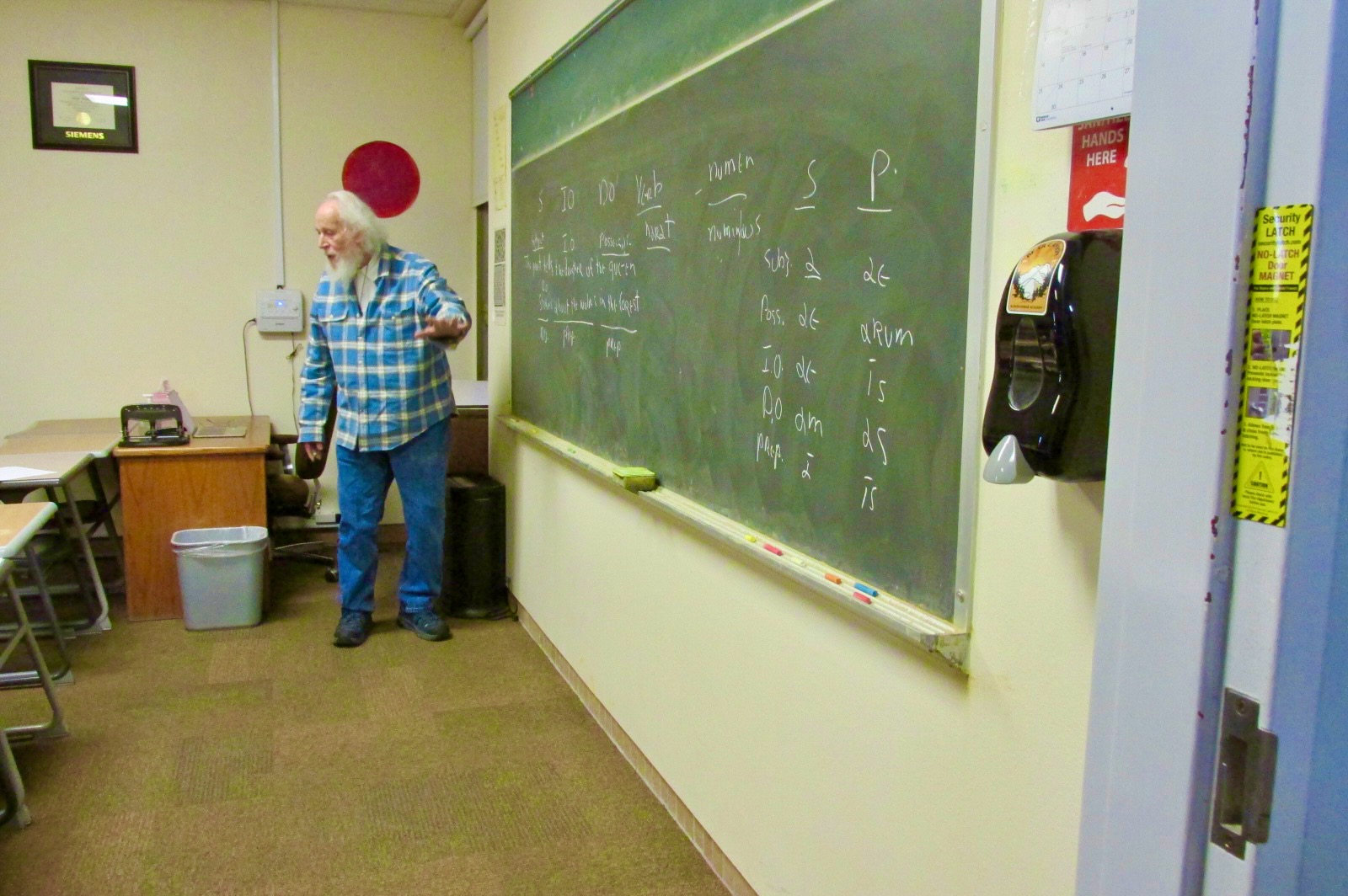
Detention certainly isn’t a place one typically likes to be. You can sense the discomposure in the room as soon as you open the door to Mr. Nelson’s classroom. It’s everywhere– from the irritated jostle of one poor victim’s leg against their vinyl desk, to the wary eyes of others as they gaze upon their proctor, Mr. Himwich. He’s the ideal caricature of a wise old man with his snow-white beard. If you look closely enough, however, you can sense he’s full of mischief. There’s a twinkle in his eyes, the kind that tells you that something is certainly brewing in his mind.
Mr. Himwich thinks that students shouldn’t be made to wither away in a room when they could be doing more useful things, like, let’s just imagine for a second, learning Latin. He has a faraway look in his eyes as he gazes upon his classroom of criminals (what crimes did they commit, you ask? 3rd degree parking violations, or worse, having the nerve to skip an assembly.)
You see, he views his detention Latin class as a form of rebellion against the established bureaucracy that has come to prioritize penalties over learning. He hopes that people will love learning this classical language so much that detention will begin to feel like a reward rather than a punishment.
The students (if they haven’t already heard about this new program) are rightfully bewildered. The idea of actually doing something during detention seems to have a transformative effect on them. The restlessness in the room is suddenly replaced with a sense of enthusiasm and vigour— instead of idly moving their limbs about or trying to find some other way to pass the time, they instead turn to their neighbor… and immediately start chatting. Perhaps they believe that the true way to decipher the mysteries of a dead language is through socializing. While I haven’t seen that method to be effective yet, there must be some merit to it. Why else would they try it?
Mr. Himwich picks up a piece of Mr. Nelson’s coveted Hagoromo chalk and writes a simple phrase onto the blackboard: SENATORES SPECTANT ELEPHANTES IN COLOSSEO. He surveys the classroom of reluctant scholars, challenging them to translate this sentence, offering them one simple piece of advice: that they already knew thousands of Latin words even before they walked into detention.
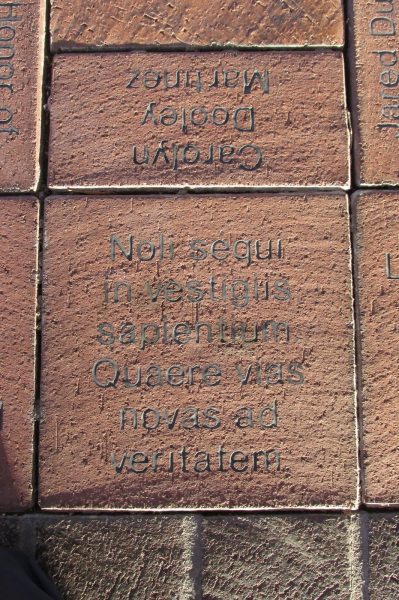
Now, detention Latin classes can also include watching the Dead Poet’s Society, learning how to conjugate verbs, and other Latin-related activities that one would usually not find in a detention room. Often, Mr. Himwich takes the class on “field trips” to the arches, where they view his brick (see image). They write Latin phrases onto the sidewalk with chalk, casually engaging in two other “crimes”: vandalism and destruction of one very notorious Math teacher’s valuable property.
According to the “magister” himself, Albuquerque Academy as an entity should “at all times need to be a school whether it is in detention or in the classroom.” By this, he means that we need to encourage learning over the traditional spirit of detention where enthusiastic students are made to sit in a room with a teacher without being taught at all: “You are there to be taught, you are there wanting to be taught, and I am here to teach. It’s a perfect match.” He recounts his days in high school, where detention consisted of acts of community service, such as raking leaves and wished that the Academy could do something similarly productive with students’ time, which inspired him to begin Latin detention classes. In the future, he hopes to expand the program by having teachers of other subjects come in to give their own lessons.
Teaching is Mr. Himwich’s passion. He has taught for over 55 years, the majority of this time spent at the Academy*, and, despite some students’ concerns, he has no plans of retiring anytime soon. In fact, he has gone so far as to say that “retirement is death”. He remarks, “this is where life is” for him, that the school allows him to stay young by “being around gifted, enthusiastic, positive young people.” This school is his proverbial elixir of youth, and the privilege to do what he does is “a gift not to be lightly set aside.” Ironically, in his time as a school student, Mr. Himwich despised Latin. However, while we were interviewing him, Mr. Himwich spoke about his own experience with great teaching during his university years, where he had a Latin teacher who not only made Latin worthwhile to him but also taught him about life in general. Now, Mr. Himwich seems to want to do the same for his students.
All in all, Latin detention is Mr. Himwich’s love letter to the Academy. It is the culmination of decades of passion and devotion not only to the language itself, but to his students. By teaching them the school motto, SCIENTIA AD FACIENDUM translated as “Learning for the Sake of Doing,” and the ancestor of the English language, he’s giving them something more than an hour-long lesson on a dead language– he is teaching them to savor the art of learning itself, a skill that will be with them throughout the rest of their lives. Though they may forget the specific mechanics of Latin they learned during detention, they’ll remember what it was like to learn for the sake of learning, from someone who teaches for the sake of teaching.





Tabitha Vaughan • Feb 3, 2026 at 12:45 pm
This was a delightful read!
Kira • Dec 21, 2025 at 9:51 pm
Love this article!
Uzair Hammad • Dec 20, 2025 at 8:49 pm
Bravo to the writers of this fascinating piece and to Mr. Himwich! Loved the conclusion too — exactly what I was thinking.
Although….I do feel slightly amused for those handful of students who take Latin as a class. Must be interesting to see one of your favorite niche subjects turned into “punishment” of some sort.